


5th Climate Talks – The Cost of Climate Inaction: What Risks for Businesses?
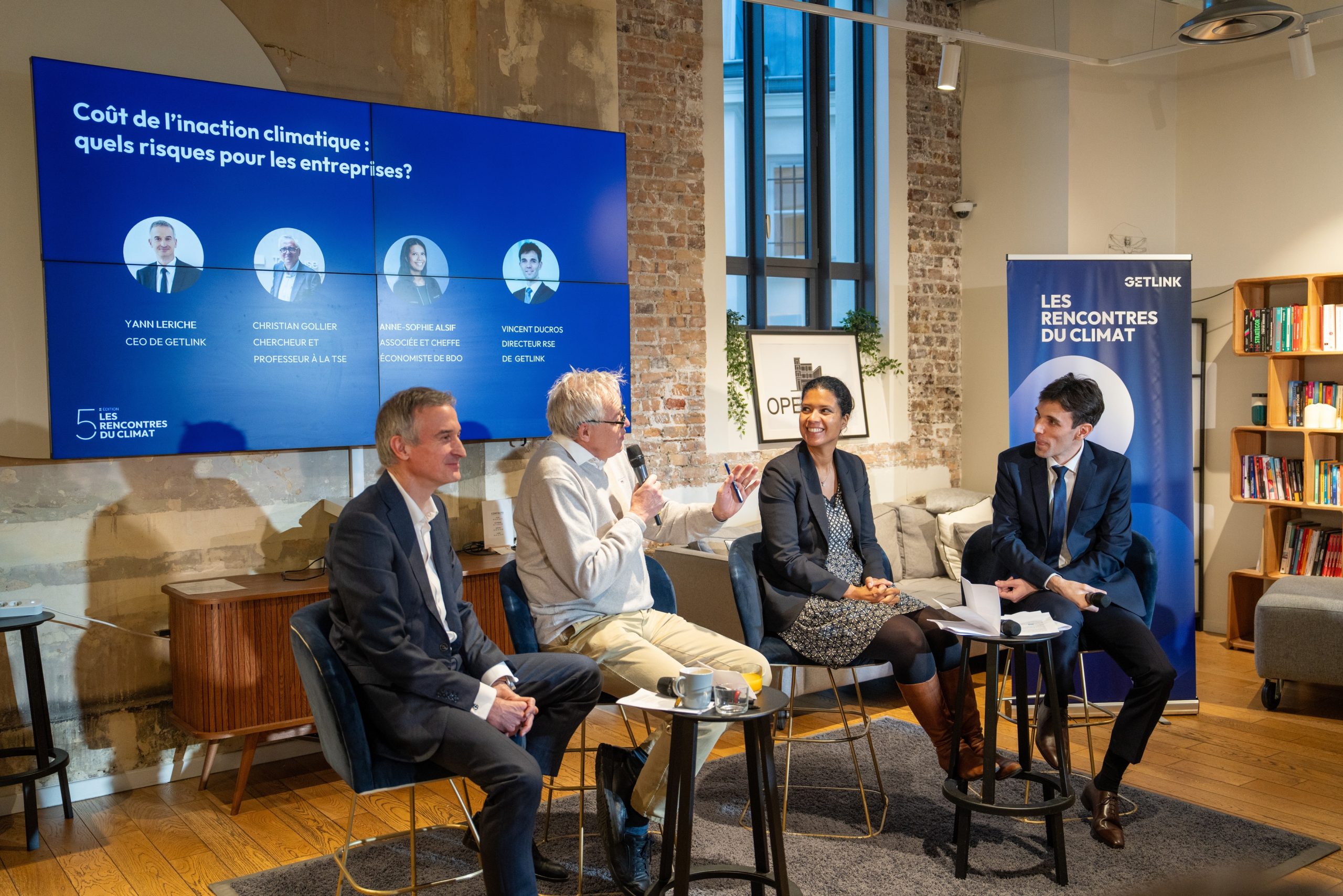
On 20 January 2026, Getlink held the fifth edition of its Climate Talks, an event that is now firmly established in the economic and climate dialogue landscape. This year’s edition focused on a central question for businesses: “The cost of climate inaction: what risks for businesses?”
True to its ambition of contributing to a reflection grounded in academic and scientific insight, this meeting builds on the research initiative launched by Getlink with the Toulouse School of Economics (TSE) in 2022, as part of its Initiative for Effective Corporate Climate Action chair.
In an international context marked by geopolitical tensions, increased budgetary pressures and heightened sovereignty concerns, Yann Leriche, Chief Executive Officer of Getlink, reaffirmed the relevance of the Group’s climate strategy, emphasising the close links between the energy transition, economic resilience and strategic autonomy.
Moderated by Vincent Ducros, Getlink’s Chief Sustainability Officer, the round table brought together, alongside Yann Leriche:
- Christian Gollier, Professor and Researcher at the Toulouse School of Economics
- Anne Sophie Alsif, Partner and Chief Economist at BDO France
The discussions addressed the limits and economic costs of insufficient climate action, as well as the levers available to reconcile environmental efficiency, economic sustainability and social acceptability. The debate drew on Christian Gollier’s recent work, including his book published in July 2025, Économie de l’(in)action climatique.
Providing an economic compass for climate action
Christian Gollier recalled the key lessons from his research, stressing the need for a robust mechanism to prioritise decarbonisation initiatives based on their cost-effectiveness. In contrast to strategies relying solely on individual goodwill – what he refers to as “climate heroes” – or on centralised planning or purely techno-solutionist approaches, he highlighted the central role of carbon pricing as an objective benchmark to guide public and private decision-making.
According to him, this approach helps direct investments towards the most effective actions: avoid excessive spending, and limit the economic risks associated with poorly calibrated choices. Towards 2030 and 2050, the gradual increase in the value of carbon is a key factor for anticipation and operational steering for companies committed to their decarbonisation pathways.
Getlink’s commitment and pragmatic approach
Yann Leriche shared Getlink’s vision and longstanding experience as a company engaged in a pragmatic decarbonisation trajectory. The Group has notably introduced an internal carbon price and developed innovative indicators, such as the decarbonised margin, to guide investment decisions and align environmental performance with economic competitiveness.
This approach aims to prioritise “no-regret” actions such as energy efficiency, the progressive electrification of uses, or the targeted renewal of equipment, while considering operational constraints and the strong competitive pressure of the markets in which the Group operates—particularly from ferry operators.
In parallel with transition efforts, Getlink is also addressing climate adaptation, notably by anticipating the impacts of extreme heat events or flood risks on infrastructure and rolling stock.
The need to structure climate action through a political and industrial vision
Anne Sophie Alsif provided additional insights drawn from her experience advising numerous companies. She emphasised that the cost of climate inaction will, in the medium and long-term, result in increased vulnerability of value chains, higher operational costs and differentiated sectoral risks.
She also highlighted contrasting trajectories across regions, where energy transition policies are increasingly intertwined with strategies for economic and industrial sovereignty, making climate transition a long-term competitiveness lever — as exemplified by industrial policies in China, notably in the solar panel sector.
Staying the course in a changing world
In conclusion, the speakers stressed the need to maintain a long-term vision, grounded in consistent public policies, innovation, investment and stronger coordination among economic actors. In an uncertain environment, the climate transition remains a structuring issue for the resilience of businesses and regions.
Watch the replay of the 5th Climate Talks
