

Jan. 2026: The cost of climate (In)action: What risks for businesses?
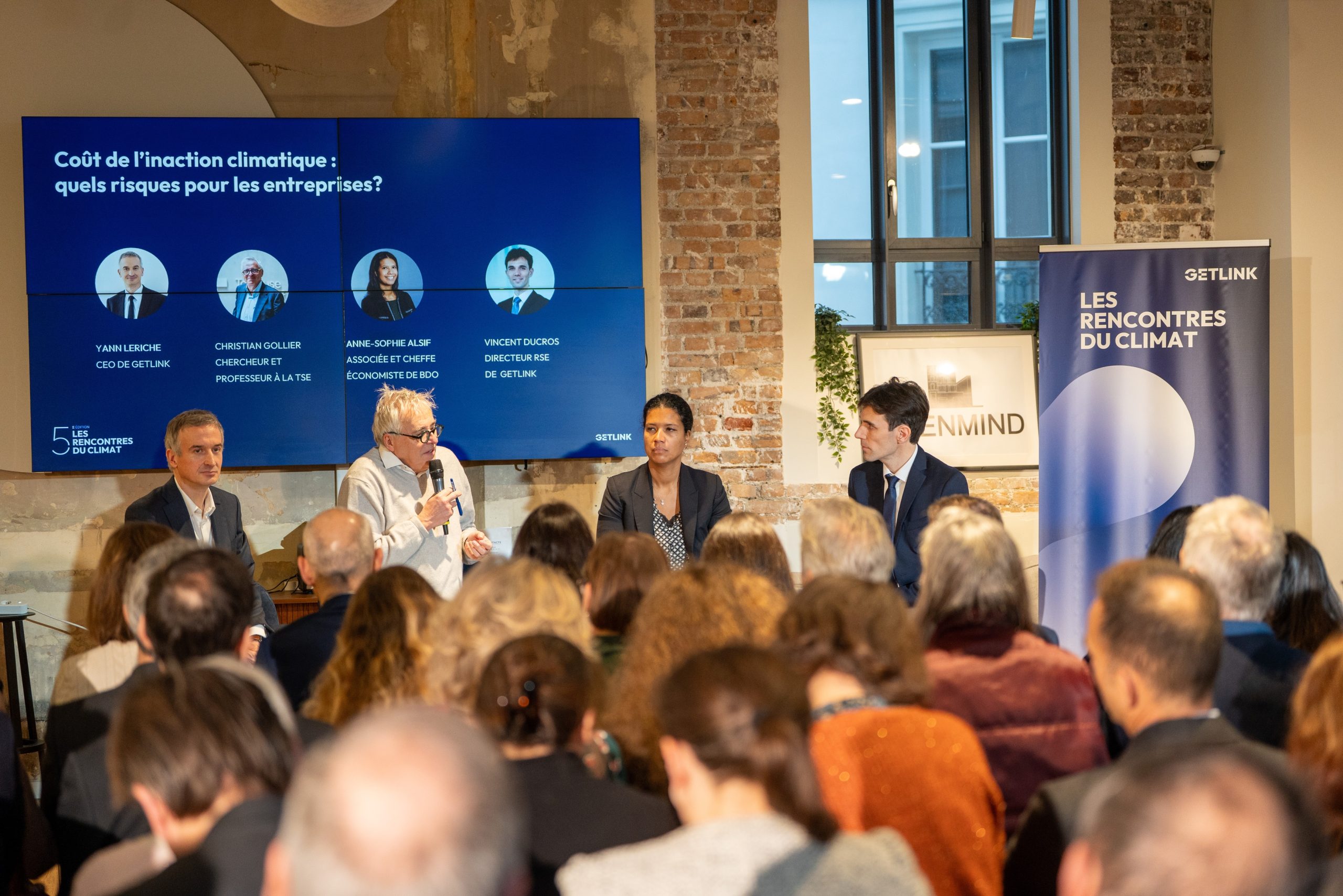
Organised on 20 January 2026 by Getlink in partnership with the Toulouse School of Economics (TSE), the 5th Climate Talk brought together economists, business leaders and decision-makers from the financial sphere to address the question of the cost of climate (in)action in terms of risks for businesses.
Against a backdrop of intensifying climate disruption and a weakening political consensus around the ecological transition, this edition shed precise light on the strategic choices companies must now confront.
The roundtable discussion brought together Yann Leriche, Chief Executive Officer of Getlink, Christian Gollier, Professor and researcher at TSE, and AnneSophie Alsif, Partner and Chief Economist at BDO France.
Drawing on his research, Christian Gollier recalled that an effective climate transition relies on a coherent and sufficiently incentive-based carbon price. As the costs linked to the impacts of climate change continue to rise, inaction will inevitably increase the final bill for all economic actors.
Sustaining Getlink’s strong climate leadership in an uncertain context
This 5th edition also took place during what speakers described as an “era of climate backlash”, characterised by increased investor caution and a tougher public debate on transition policies. The participants stressed that this period of uncertainty is testing the resilience of corporate climate strategies, without calling into question the need to act. It does, however, require a rethinking of the climate engagement narrative, highlighting not only environmental benefits but also advantages in terms of competitiveness, technological innovation, industrial sovereignty and the security of value chains.
Anticipating the risks of the ecological transition: a decisive issue for businesses
The discussions highlighted a key point: an anticipated transition is significantly less costly than a forced one. Physical risks, asset losses, regulatory instability and market volatility already represent tangible costs that weaken the least prepared actors. Conversely, companies investing in emissions reduction, electrification, renewable energy or low-carbon innovation strengthen their competitiveness while contributing to European strategic autonomy. The transition also opens the door to new markets, the consolidation of industrial positions and a better response to growing investor expectations regarding non-financial performance.
Getlink’s pragmatic low‑carbon strategy
During the Forum, Yann Leriche presented Getlink’s vision and experience, underpinned by a long‑standing commitment to a pragmatic decarbonisation strategy. In particular, the Group has introduced an internal carbon price and developed the concept of “decarbonised margin”, a financial indicator designed to guide investment decisions by reconciling environmental and financial performance.
Alongside transition challenges, Yann Leriche also stressed that Getlink is actively addressing adaptation to the physical risks of climate change, notably by anticipating the effects of extreme heat events or flood risks with consequences for infrastructure and rolling stock.
Economic and industrial sovereignty: transition as a lever for competitiveness
Anne-Sophie Alsif provided insight into the contrasting trajectories across geographical areas, where energy transition policies are increasingly intertwined with strategies for economic and industrial sovereignty, making the climate transition a lever for long-term competitiveness. This demonstrates that ecological ambition and economic ambition cannot be separated.